Prestigious University Degree
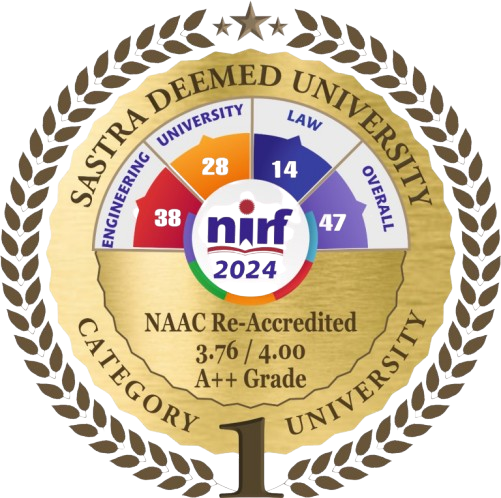
Gain a recognized Masters' degree from top ranked SASTRA University, with a University ranking of #29 in NIRF 2025.




The Master of Science (M.Sc.) in Data Science Online degree program is designed to equip students with advanced knowledge and skills in data science, a rapidly growing and in-demand discipline. This program blends theoretical concepts with practical applications, preparing graduates for successful careers in various industries, such as technology, finance, healthcare, and more.
The Online M.Sc. in Data Science program curriculum covers a wide range of topics essential to the field, including data analysis, machine learning, data visualisation, statistical methods, and big data technologies.
The program emphasises critical thinking, problem-solving, and analytical skills, preparing graduates to tackle complex data challenges in today's data-driven world. Graduates are well-equipped to pursue roles such as data scientist, data analyst, machine learning engineer, business intelligence analyst, and more.
Gain a recognized Masters' degree from top ranked SASTRA University, with a University ranking of #29 in NIRF 2025.
Study from anywhere, at your own pace, ideal for working professionals.
Covers data analysis, machine learning, programming languages like Python and R, statistical methods, and big data technologies.
Engage in practical projects and real-world case studies to build a professional portfolio and apply knowledge effectively.
Gain skills in critical thinking, problem-solving, and data-driven decision-making, positioning graduates for roles like data scientist, machine learning engineer, and more.
Download the official brochure for detailed syllabus, faculty and fee information.
Download BrochureTrain learners to demonstrate proficiency with statistical analysis of data.
Online M.Sc in Data Science equips graduates with the necessary skills to execute statistical analyses with professional statistical software.
Enable graduates to create and implement solutions with advanced computing skills addressing data management.
Prepare learners to develop the ability to build and assess data-based models.
Equip graduates with the capability to design, implement and test computational approaches to develop innovative and effective solutions for diverse sectors.
Enable the learners to apply data science concepts and methods to solve problems in the real-world context and communicate these solutions effectively.
Online Data Science Masters nurtures creativity in graduates to enable them to excel in industry and research organisations.
Create technically sound, socially conscious and ethically committed professionals.
| Course Code | Subject | Credit |
|---|---|---|
| MATOL445 | Probability & Statistics using R | 4 |
| MATOL446 | Mathematics for Data Science | 4 |
| BINOL522 | Python for Data Science | 4 |
| INTOL530 | Artificial Intelligence & Reasoning | 4 |
| MATOL439 | Applied Multivariate Analysis | 4 |
| Total Credits | 20 |
| Course Code | Subject | Credit |
|---|---|---|
| INTOL534 | Machine Learning | 4 |
| CSEOL614 | Big Data Mining & Analytics | 4 |
| INTOL413 | RDBMS, SQL & Visualization | 4 |
| INTOL531 | Data Mining Techniques | 4 |
| INTOL416 | RDBMS, SQL, Visualization & Analytics Laboratory | 2 |
| MANOL106 | Research Methodology & IPR | 2 |
| Total Credits | 20 |
| Course Code | Subject | Credit |
|---|---|---|
| CSEOL615 | Deep Learning & Applications | 4 |
| INTOL418 | Predictive Analytics Regression & Classification | 4 |
| OEHOL014 | Ethics & Data Security | 4 |
| XXXXXX | Elective I | 4 |
| XXXXXX | Elective II | 4 |
| Total Credits | 20 |
| Course Code | Subject | Credit |
|---|---|---|
| ICTOL601 | Machine Vision | 4 |
| XXXXXX | Elective III | 4 |
| XXXXXX | Elective IV | 4 |
| INTOL500 | Project Work & Viva Voce | 8 |
| Total Credits | 20 |
| Course Name |
|---|
| Algorithmic trading |
| Bayesian data analysis |
| Financial data analysis |
| Healthcare data analytics |
| Data science for structural biology |
| Epidemiological Modelling |
| Social Networks & Graph Analysis |
| Spatial Data Analytics |
| Information Visualization |
| Image processing & Analysis |
| Speech & Video processing |
| Information Retrieval & Natural Language Processing |
| Energy Systems Modelling & Analysis for Data Science |
A pre-recorded video of an expert delivering a lesson or presentation on a particular topic.
Videos will be uploaded on a weekly basis for 12 weeks.
Videos will be available till semester completes.
Any time access across devices.
Asynchronous mentoring.
E-books, lecture notes, PPT and open-source materials.
The contents will be a mix of all the above available for the students to use comprehensively.
All materials will be made available from day 1 for the entire semester students can download.
It can be accessed any time across devices.
Synchronous teaching & learning.
Students must go through / study the previous three weeks content before sitting for webinars.
Each webinar is two hours long and occurs every alternate week of the programme (2, 4, 6, 8, 10, and 12th weeks).
This session will be doubt-clearing sessions only of previous weeks content.
Each assessment will be MCQs / Descriptive patterns.
Totally 6 assessments starting from 3rd week of the programme (3,5,7,9,11,13 weeks).
All courses will have 6 assessments out of which best of 5 will be taken into consideration and it is compulsory.
Work as a Data Science professional in the corporate sector, academia, or research organisations.
Use, analyse, and visualise data using specialised software tools.
Undertake research/investigation independently and display teamwork and leadership skills to solve real-life problems.
Apply computing theory, languages, algorithms, mathematical and statistical models, and the principles of optimisation to formulate and use data analysis in diverse sectors.
Integrate concepts of data science and mathematics to contribute towards key technologies including data mining, machine learning, visualisation, predictive modelling and statistics.
Engage in lifelong learning and employ technical knowledge to address economic, environmental, health, national, global, cultural, societal and sustainability issues.
Graduate/Bachelors degree (10+2+3 or 10+2+4) or equivalent in any discipline but with a background in Mathematics or Statistics, from a recognized university.
Strong brand image of SASTRA in the corporate sector
Semester-pattern
Interactive learning content and Self Learning Materials (SLM)
Personal Contact classes
Highly qualified and experienced faculty
Affordable fee structure with loan facility at attractive rates
Internal Assessment – 30 marks + End semester Exam – 70 marks
| Semester | I | II | III | IV | Total |
|---|---|---|---|---|---|
| Courses | 5 | 6 | 5 | 4 | 20 |
| Credits | 20 | 20 | 20 | 20 | 80 |
For Students in India
*The above discounted fee is applicable for the July 2026 batch admissions.
Interactive learning content and Self Learning Materials (SLM)
Live interactive sessions with SASTRA faculty and contact classes as specified
Semester exam fees for all 4 semesters
Convocation Fee
Re-exam fees for any subsequent attempts
Any other administrative charges that are not covered above
Make a down payment of Rs.20000 and avail loan/financial assistance for the balance fee.
Pay Semester fee on or before the specified last date.
Pay the annual fee upfront on or before the specified last date.
Pay the full programme fee on or before the specified last date.
Complete your registration form today — the July 2026 batch.
Throughout the online course, participants will undergo periodic evaluations, including quizzes, class assignments, projects, case analyses, or other objective/subjective assessments as determined by the instructor during class hours.
Timely and successful completion of these evaluation components is essential. Participants are expected to demonstrate active engagement and meet all requirements within the given timelines.
SASTRA University will award a Course Completion Certificate to those who:
Successfully complete all assessment components.
Meet the specified attendance criteria.
The primary objective of the assignments and projects is to enable participants to apply the conceptual insights gained during the programme to real-world organizational decision-making scenarios.
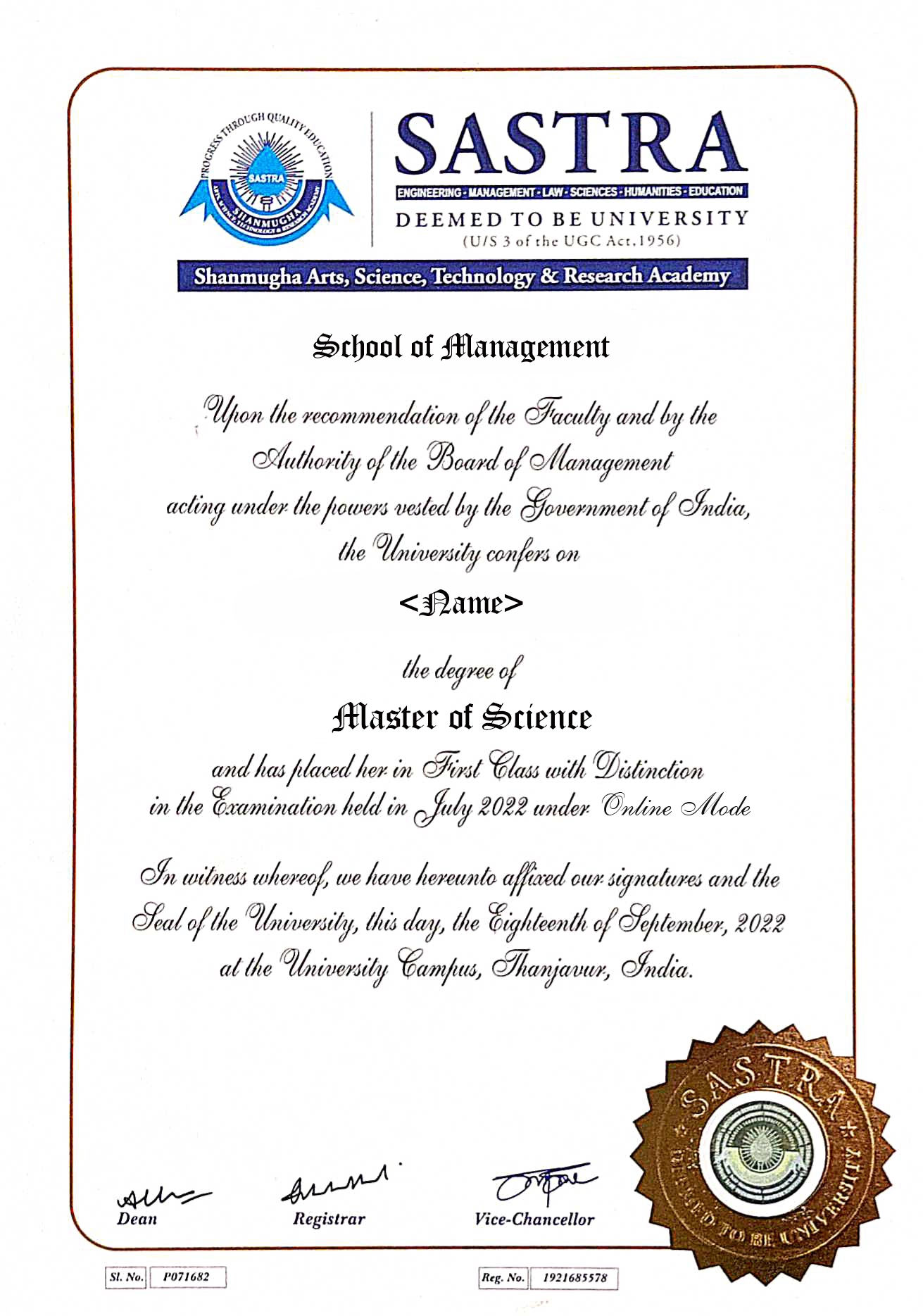
Download Sample Certificate













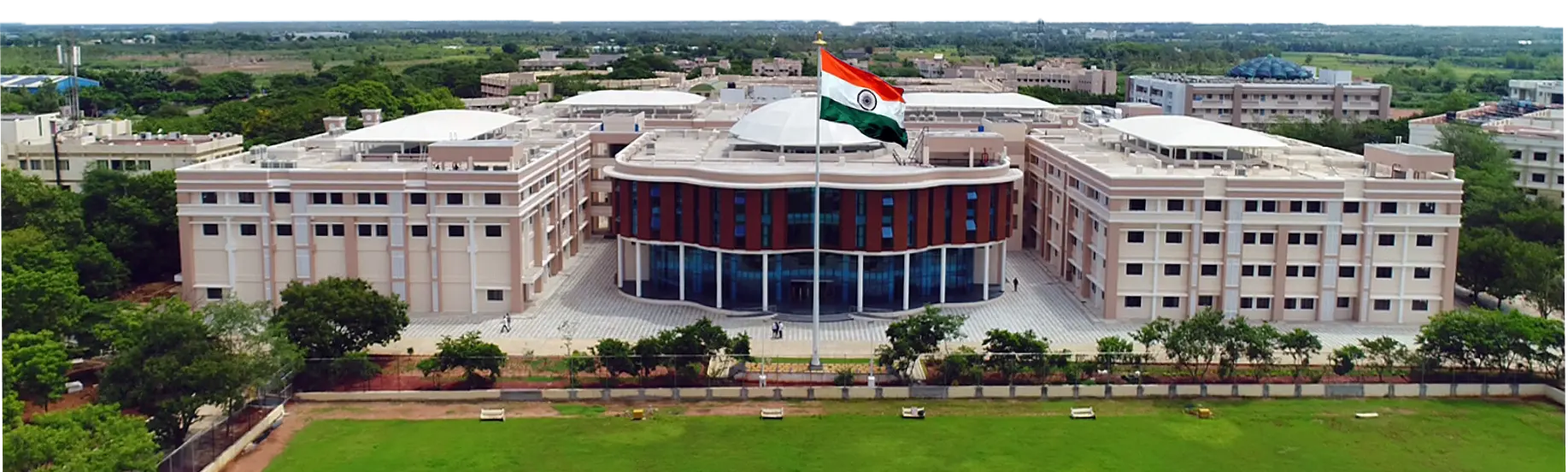
With a humble beginning in the year 1984, SASTRA's progress in the last 36 years is a testimony to its commitment to building a University as envisaged in its guiding model. Today, SASTRA is one of India's premier institutions offering undergraduate, postgraduate & doctoral programmes in Engineering, Management, Law, Sciences, Humanities and Education. It was conferred Deemed-to-be-University status in 2001 by the University Grants Commission under Section 3 of the UGC Act 1956. SASTRA also has an MHRD-notified off-campus named Srinivasa Ramanujan Centre (SRC) at Kumbakonam.
As a comprehensive University, its teaching programmes are complemented by research engagements, consultancy assignments, training and extension activities. This has been re-accredited by NAAC (fourth cycle) with the maximum grade of 'A++' (3.76/4.00). It is also recognized as a Category I Institution based on the UGC's categorization of universities under the Graded Autonomy Regulations, 2018. Twelve engineering programmes of SASTRA have been internationally accredited for a period of 9 years by the Institution of Engineering & Technology (IET), UK recognizing SASTRA's academic excellence. In the NIRF ranking, SASTRA has always been placed among the top 40 Universities with a current position of #29 in 2025. It is also recognized as a Scientific & Industrial Research Organization by the Government of India.